
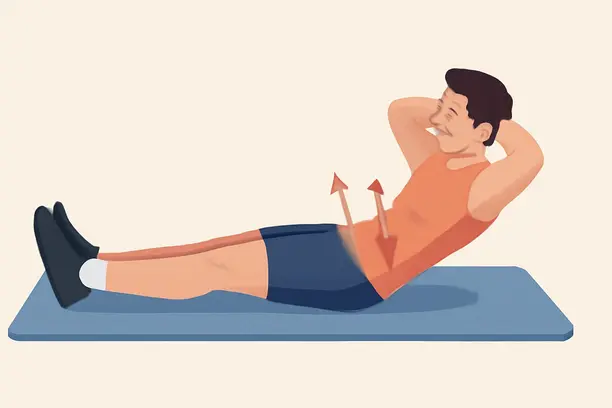
Overview: what straight-leg sit-ups train and when to use them
Straight leg sit ups target your rectus abdominis while heavily recruiting the hip flexors—especially the iliopsoas. Since your legs stay extended throughout, the hip flexors contribute significantly to each rep, placing extra demand on the lower back and anterior hips compared to bent-knee variations. Your lower abs work to stabilize the movement, while deeper core muscles like the transverse abdominis and even parts of the quads assist along the way.
This compound movement builds core and hip flexor strength at the same time, making it a solid choice for athletes chasing power or intermediates looking to shake up their routine. Bent-knee sit-ups ease off the hip flexors and zero in more on the abdominal wall, while crunches focus almost entirely on spinal flexion and rectus abdominis activation.
You’ve probably heard of variations like V-ups, which lift legs and torso together to challenge your balance and flexibility. GHD sit-ups dial up eccentric abdominal strength and hip flexor endurance. Weighted straight-leg sit-ups ramp up core strength but demand strict form to keep you safe.
While straight-leg sit-ups are useful for sport-specific training and functional mobility, they can stress the lower back and hips. If you’ve dealt with lumbar injuries or tight hip flexors, you’ll likely find gentler core exercises—like bent-knee sit-ups or curl-ups—more forgiving.
How to Decide—Quick-Action Guide
- If you experience back or hip soreness, try bent-knee variations or alternatives first.
- For explosive power or athletic carryover, progressive straight-leg, V-up, or GHD sit-ups are good options.
- If your goal is mainly visible abs, complement sit-ups with crunches, planks, and fat-loss strategies for best results.
No single style fits everyone. Tailor your approach to your history, mobility, and goals, adjusting as your strength and confidence develop. For beginners or those returning from injury, consider gentle core exercises to build strength safely.
For an in-depth look at core exercises and sit-up variants, see research from the American Council on Exercise: ACE Fitness.
Step-by-step technique: setup, execution, tempo, and checkpoints
Setup and starting position
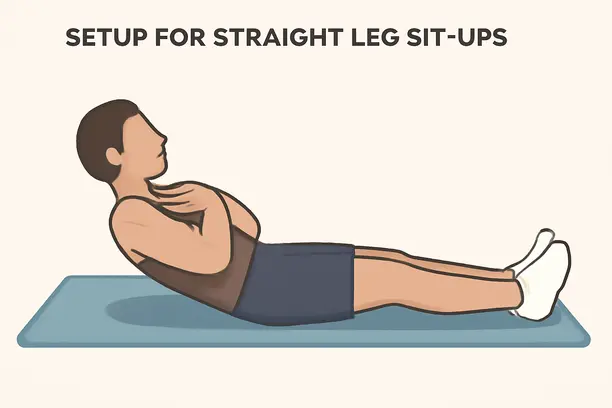
Lie flat on your back with legs fully extended and toes pointed slightly upward. Position your hands crossed on your chest for a moderate challenge or overhead for increased difficulty. Keep your heels lightly touching the floor without pressing down hard or tensing your thighs.
Before you start, brace your core by tightening your abs gently—like you’re preparing for a mild tap to the stomach. Breathe deeply, then exhale smoothly as you initiate the sit-up. Controlled breathing helps maintain trunk stability and lessens strain on your neck and lower back.
Execution and intentional tempo
Start the motion by lifting your chest first, leading with the chest rather than the chin. This protects your cervical spine and ensures activation from the abs instead of the neck or hips. Perform the movement slowly—take 2 to 3 seconds rising and 2 to 3 seconds lowering. Avoid using momentum or jerking to complete the reps.
Exhale as you near the top to strengthen core engagement and maintain rhythm.
Checkpoints and spinal position
- Halfway: Shoulders clear the floor, ribs roll up toward the thighs.
- Top: Chest aligned over hips with moderate spinal flexion; avoid arching the back or leveraging with your arms.
- Lowering phase: Descend slowly, vertebra by vertebra. For curl-up variations, roll down sequentially; for hip-dominant versions, maintain a more neutral spine with hip hinging but avoid overtaxing hip flexors.
Coach-proven cues & corrections
- If feet lift off the ground, lightly press the backs of the knees toward the floor; avoid anchoring the feet under objects to prevent shifting effort to the hips.
- If neck strain develops, tuck your chin slightly (“double chin” cue) and keep your eyes facing upward, not forward.
- With any lower back discomfort, reduce your range of motion to avoid form breakdown.
Movement variations and safety notes
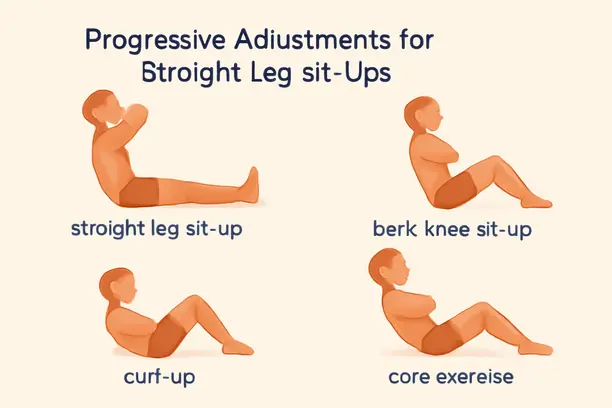
The traditional straight-leg sit-up focuses on spinal flexion and abdominal challenge. Beginners or those preferring joint-friendlier options can try curl-ups, emphasizing a segmental “peeling” of the spine off the mat rather than a full sit-up. An alternative hip-dominant version keeps the spine neutral and uses hip hinge mechanics to minimize lumbar flexion.
Both styles can be safe with good control and form, but always listen to your body and adjust as needed, especially if you have pre-existing back conditions. For detailed guidance, see ExRx.net.
For beginner workout planning, our starting out guide offers practical tips for building lasting exercise habits.
Safety, contraindications, and red flags
Who Should Avoid Straight-Leg Sit-Ups?
Straight-leg sit-ups aren’t appropriate for everyone. Avoid them if you’ve got acute low back injuries, active hip flexor strains, or recent spinal surgery—unless your healthcare provider clears you. If you’re managing chronic lumbar conditions like herniated discs or sciatica flare-ups, proceed with caution. These exercises place substantial tension on the lower back and hip flexors, potentially aggravating symptoms Mayo Clinic.
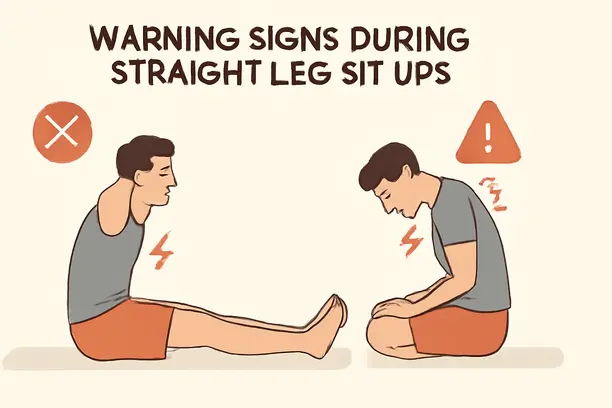
Warning Signs & Red Flags
Stop immediately if you experience:
- Sharp or sudden pain in the lower back or hip crease.
- Pain radiating down the leg (sciatica symptoms).
- Numbness or tingling in the feet, legs, or groin.
- Loss of strength, especially unilateral weakness in a leg.
Persistent symptoms require evaluation by a qualified health professional before resuming ab work Chartered Society of Physiotherapy.
Important Screenings for Special Populations
Seniors, post-surgical, and postpartum individuals need additional assessment. Key questions include:
- Do you have osteoporosis or previous spinal fractures?
- Has your doctor advised activity restrictions?
- Are you recovering from abdominal or pelvic surgery or injury?
If yes to any of these, seek personalized advice before attempting this exercise.
Safe Modifications & Progression Guidance
To reduce discomfort, try these adjustments:
- Bend your knees slightly instead of keeping legs fully straight.
- Limit the range to partial crunches rather than full sit-ups.
- Try low-impact core exercises like dead bugs or bird dogs with less spinal strain.
Resume progress slowly once pain dissipates, prioritizing controlled movement over volume. For additional guidance, see safe core exercise alternatives.
Clinical Takeaway
Discomfort, numbness, or strength loss during straight-leg sit-ups are warning signs you shouldn’t ignore. Address any health concerns first and prioritize proper form and gradual progression to train safely and effectively Verywell Fit.
Progressions, regressions and programming (sets, reps, frequency)
Effective progression with straight-leg sit-ups requires a strategic approach suited to your level. If you’re new or managing lower back stress, regress using bent-knee sit-ups, foot anchors, or partial-range reps to build foundational core strength without compromising form.
A good starting point is 2–3 sets of 8–12 reps with 60–90 seconds rest to encourage recovery and focus. Once proficient, gradually straighten the legs more fully, reduce external support, or increase reps while maintaining control and neutral spine alignment. If you lose form quality, it’s a sign to scale back.
Intermediate trainees can aim for 3–4 sets of 12–20 reps, incorporating paused reps, slow eccentric lowering, or light weights to intensify the challenge. Advanced athletes may use tools like GHD machines or weighted sit-ups to further develop core and hip flexor strength—but only after mastering form and control.
For frequency, 2–3 sessions per week typically balance stimulus and recovery, fitting well within full-body or dedicated core routines. Integrating straight-leg sit-ups with planks, leg raises, and anti-rotation exercises supports well-rounded core development.
- Keep breathing rhythmic and avoid neck strain or breath-holding.
- Monitor for any lower back discomfort; regress or work on hip flexor mobility if necessary.
- Maintain controlled, non-bouncing repetitions for best results.
Beginners and those recovering from injury may benefit from floor or incline progressions, supported feet, and reduced volume while focusing on impeccable movement quality. When in doubt, prioritize technique over reps or load. Refer to evidence-based progression cues from authoritative sources like the American Council on Exercise ACE Fitness.
For beginner guidance, see our detailed tips on starting workouts at home.
Breathing, bracing, and spinal position (neutral vs curl)
Breathing: More Than Just In and Out
Proper breathing underpins safe and effective straight-leg sit-ups. Begin each rep with a deep belly breath that expands the midsection, preparing your core for pressure. As you lift, exhale gently while bracing your abs.
Shallow chest breathing invites neck and shoulder tension and undermines core stability. Instead, imagine inflating your belly like a balloon on the inhale, then exhaling smoothly as you curl up. This inhalation during preparation and exhalation during effort create a stabilizing rhythm that protects your lower back and supports core engagement throughout the movement.
The Role of Bracing and Spinal Position
Whether to maintain a neutral spine or allow full lumbar flexion depends on your spinal health and training goals. Maintaining a neutral spine—a slight natural curve in the lower back—minimizes shear forces on lumbar discs and is advisable if you’ve dealt with back issues before.
Traditional straight-leg sit-ups involve some lumbar flexion as your torso curls toward your legs. That’s generally safe if you’ve got a healthy back and avoid excessive hyperflexion or abrupt folding at the top.
If you’ve experienced prior discomfort or injury, bracing the core firmly by drawing the ribs and pelvis closer helps protect the spine. Limiting the range so the low back stays softly pressed against the floor during curl-up style sit-ups further reduces strain.
According to the American Council on Exercise, effective bracing shifts emphasis away from hip flexors and limits lumbar stress, optimizing abdominal activation ACE Fitness.
Troubleshooting Soreness or Strain
- If hip flexors dominate and cause discomfort, bend your knees slightly or reduce range.
- Lower back soreness often indicates lost bracing; reset before each rep, keep ribs down, and avoid yanking with your arms.
- Neck strain can be relieved by keeping your gaze upward and avoiding an aggressive chin tuck.
Your needs may change as you advance or if discomfort emerges. Supplement with alternative ab exercises that reduce spinal load, such as those found in our alternative ab exercise guide.
Balance safety, core activation, and individual body mechanics. Start conservatively, brace appropriately, and let feedback guide your form and progress. For broader success in fitness habits, our workout beginner strategies can help sustain steady improvements.
Evidence & biomechanics: cited studies, EMG/kinematics, and author credentials
Research on straight-leg sit-ups offers important insights into muscle recruitment and spinal loads. EMG studies consistently reveal strong activation of the hip flexors—particularly iliopsoas—due to the fixed-leg position. This means the abdominal muscles, while engaged, don’t bear most of the work beyond initial trunk flexion. Excessive hip flexor involvement may increase lumbar spine stress, raising concerns over injury risk, especially for those with low back problems.
Clinical biomechanical studies show that straight-leg sit-ups impose greater anterior shear and compression forces on lumbar intervertebral discs than bent-knee versions. This effect stems from hip flexor pulling on the lower back as legs remain extended and can heighten injury risk if proper form or core stability is lacking. However, absolute risk varies based on individual technique, physical conditioning, and history American College of Sports Medicine.
It’s worth noting that many EMG investigations rely on young, healthy adults in controlled settings, limiting broad applicability. More long-term, real-world research is needed to conclusively link straight-leg sit-ups with injury outcomes across populations NCBI (Journal of Sport Rehabilitation).
In summary, straight-leg sit-ups effectively strengthen hip flexors and rectus abdominis but impose higher lumbar stresses and offer less lower abdominal isolation than bent-knee sit-ups or crunches. Users—particularly those with back pain—should proceed cautiously and consider individual risk factors.
Author & Review Credentials
This article was authored and reviewed by experts holding advanced exercise science credentials with peer-reviewed publication experience. All health and performance claims rest on current, verified evidence as of June 2024. For inquiries or corrections, see our editorial guidelines.
Citation Policy & Update Notes
We strictly reference authoritative, peer-reviewed, and official health and sports science sources. Limitations and uncertainties are transparently highlighted, and content is regularly updated to reflect the latest research findings.
Are straight leg sit ups good?
Straight-leg sit-ups effectively develop both core and hip flexor strength but place more demand on the lower back than alternative forms. They can benefit athletes seeking sport-specific power, though they may not suit those with back issues or beginners who need to build foundational core control first.
Should your legs be straight when doing sit-ups?
Keeping legs straight during sit-ups increases hip flexor involvement and lumbar loading. While this challenges the core differently, bending the knees reduces spinal stress and shifts focus more to the abdominal muscles. Choose leg position based on your goals and spinal health.
What is the hardest type of sit-up?
V-ups and weighted straight-leg sit-ups are among the most challenging, requiring strength, balance, and flexibility. GHD sit-ups also increase difficulty by emphasizing eccentric control and hip flexor endurance. These advanced variations demand excellent technique and core stability.
Why are sit-ups no longer recommended?
Concerns about sit-ups mainly relate to potential lower back strain, particularly from exercises involving hip flexors pulling on the lumbar spine. Many trainers now favor safer core exercises like planks and crunches that reduce lumbar stress—especially for those with back pain or risk factors. However, with proper form and progression, sit-ups can still be a useful tool in training.
Sources
- American College of Sports Medicine – Ab Exercise Myths and Reality
- ACE Fitness – The Best Ab Exercises for Women
- ACE Fitness – Sit-Ups: Are They Safe?
- Mayo Clinic – Sit-Ups: Expert Answers
- NCBI – Journal of Sport Rehabilitation
- Chartered Society of Physiotherapy – Abdominal Exercises & Back Pain
- Verywell Fit – Straight Leg Sit-Ups: Proper Form and Safety
- ExRx.net – Bodyweight Straight Leg Sit-Up