
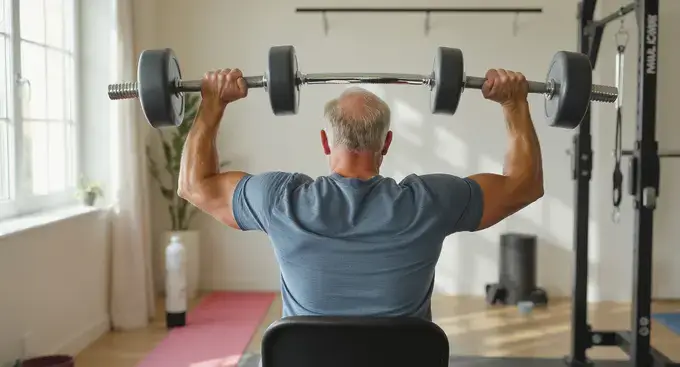
Essential Dumbbell Exercises for Seniors: A Safe Foundation
Dumbbell exercises for seniors offer a practical, effective way to build strength, sharpen balance, and preserve the independence you value. The focus here is simple: master the movement patterns with light weights first, reduce your fall risk, and enhance the functional fitness that makes everyday life easier.
If you’re an older adult thinking about strength training, you’ll want a thoughtful plan that puts safety and proper technique front and center. The American College of Sports Medicine notes that only about 19% of older adults currently meet muscle-strengthening recommendations. Yet the payoff for those who do is significant—especially when it comes to maintaining independence. Source: ACSM
Before you even pick up a weight, spend time practicing the movement using just your body. This foundational step helps your nervous system learn the right patterns and dramatically cuts your injury risk. Since dumbbells carry a bit more risk than resistance bands, nailing down correct form from the start really matters.
Key Safety Principles for Every Movement
No matter which dumbbell exercise you’re doing, a few safety cues apply across the board. Keep your spine neutral—don’t let your back round during lifts. Control every rep, especially the lowering phase, to protect your joints and get the most from each movement.
Breathe naturally: exhale as you exert, inhale as you ease back. And start ridiculously light. Your first goal isn’t lifting heavy; it’s perfecting your technique. Some trainers even suggest running through your entire workout with zero weight to build confidence before adding resistance.
If you’re working on building consistency, our guide on how to stay motivated to workout has practical strategies that can help. And if joint concerns are holding you back, try starting with low-impact exercises for bad knees before adding weights into the mix.
A proper warm-up is non-negotiable—light cardio and dynamic stretching prepare your muscles and joints for the work ahead. Cool down afterward with static stretches targeting what you just trained.
Most importantly, listen to your body. Sharp pain, dizziness, or discomfort beyond normal muscle fatigue? Stop immediately.
Is dumbbell exercise good for seniors?
Absolutely. When done correctly, dumbbell training helps you build and maintain muscle mass, which is crucial for metabolism, bone density, and functional independence. The key is prioritizing safety, choosing appropriate weights, and focusing on form to maximize benefits while keeping risk low.
Safety First: Modifications and Contraindications for Common Conditions
If you’re managing a health condition, you’ll need to adapt your dumbbell routine carefully. Individual mobility levels and medical history matter here, and chair-based exercises often provide the stable foundation you need.
Condition-Specific Modifications
Osteoporosis/Osteopenia: Skip exercises involving spinal flexion, rotation, or high impact. That means no traditional crunches, sit-ups, toe touches, or twisting motions with weight. Source: Seaton Senior Living
Instead, focus on upright, supported movements like seated overhead presses or bicep curls. These build strength without compromising your spine.
Hypertension: Your blood pressure response to resistance training depends on intensity, breathing technique, and how much muscle you’re engaging. If your resting blood pressure is very high, hold off on resistance training until you’ve talked to your doctor. Source: Cooper Institute
Use lighter weights, breathe properly (exhale on exertion), and never hold your breath. Track your blood pressure before and after sessions, at least initially.
Joint Replacements (Hip/Knee): Stick strictly to your post-surgical precautions. If you’ve had a hip replacement, avoid crossing your legs, deep flexion, and internal rotation. For knee replacements, skip high-impact activities. Source: Franciscan Health
Seated leg extensions with light ankle weights or gentle dumbbell heel raises are often safer than standing squats or lunges.
Chair-Based Modifications for Varying Mobility
Chair-based workouts give you stability and can be scaled to match your current ability. If standing balance is an issue, perform all exercises seated firmly with back support. As you gain confidence, you can progress to seated without back support (engaging your core more) or try supported standing moves while holding the chair.
- Limited Mobility: Do all upper-body dumbbell work (curls, presses, raises) seated with full back support. For lower body, stick to seated leg lifts, ankle circles, and heel/toe raises.
- Moderate Mobility: Add seated marches, controlled “chair squats” (standing up and sitting down slowly), and light standing calf raises while holding the chair.
- Higher Mobility: Use the chair for support during standing exercises like modified lunges or light Romanian deadlifts, keeping stability your top priority.
Critical Contraindications & The Essential Consultation
Certain warning signs mean you need to stop immediately. Sharp or increasing joint pain, dizziness, chest pain, or severe shortness of breath—all red flags. If an exercise causes pain in a replaced joint or feels unstable, it’s contraindicated for you.
The most critical step before you start any new routine? Talk to your healthcare provider. This is especially important if you have diagnosed conditions. A doctor or physical therapist can give you personalized clearance, identify specific movement restrictions, and help tailor a program that fits your health status and goals.
Don’t assume a generic exercise is safe without this professional guidance.
What are the 5 dumbbell exercises for seniors?
Five foundational, safe dumbbell exercises are: seated overhead press, seated bicep curls, seated leg extensions (with ankle weights or light dumbbells), supported goblet squats, and bent-over rows (leaning on a chair for support). These movements target major muscle groups while providing the stability and controlled patterns essential for safety.
Building a Sustainable Routine: Progression and Methodology
Getting stronger long-term means going beyond random sets and reps. For seniors, the smart approach is periodization—planned variation in your workout’s intensity and volume over time to keep your body adapting and prevent plateaus.
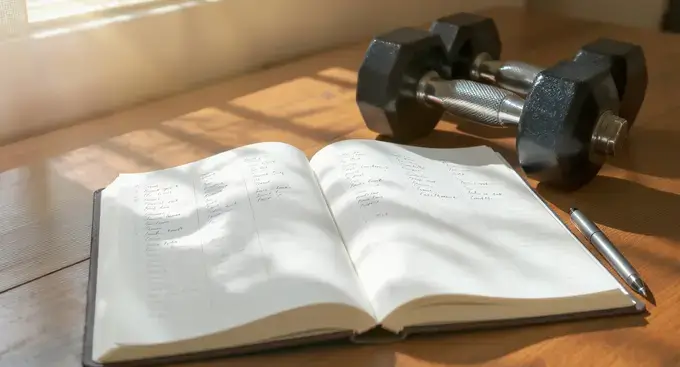
A practical method is linear periodization. You’ll gradually increase the weight you lift over time. Start a training block with a weight that lets you complete your reps comfortably with good form. Each week, aim to bump up the weight slightly or squeeze out more reps with the same load. After several weeks of this progressive overload, schedule a deload week.
The Essential Role of Deload Weeks
Deload weeks are planned breaks where you significantly reduce training stress—typically cutting your usual weight and volume—to allow full recovery. For older adults, whose recovery systems work more slowly, these breaks aren’t optional. Source: B-One Training recommends incorporating a deload every few weeks of consistent training. You may need one more frequently depending on sleep quality and overall fatigue.
This strategic recovery prevents the cumulative fatigue that stalls progress or triggers injury. During a deload, keep your exercise frequency and movement patterns, but use much lighter dumbbells. This active recovery maintains your mobility and technique while your body repairs—setting you up for stronger performance in the next training block.
Practical Tracking for Sustained Motivation
Want to stay motivated? Track your progress. Use a simple notebook or app to log three key metrics for each exercise: weight used, reps completed, and how the set felt (like “challenging but controlled”). Watching those numbers climb—even by tiny increments—gives you concrete proof you’re improving.
Don’t just track numbers. Note qualitative wins too: daily tasks feeling easier, better balance, more energy. This holistic view celebrates the full spectrum of benefits from your strength training.
When motivation dips, flip back through your log. Seeing how far you’ve come can reignite your drive. For more on staying consistent, check out our guide on how to stay motivated to workout.
By combining periodized progression with regular deloads and diligent tracking, you’ve built a sustainable framework. This methodology ensures your dumbbell exercises for seniors keep delivering strength gains, functional improvements, and long-term health benefits—while keeping you engaged and injury-free.
Choosing the Right Dumbbells and Supporting Your Training
Picking the right dumbbells isn’t just about weight. Ergonomics and manageable progression matter for safety and long-term success. Look for dumbbells with textured, non-slip grips that feel comfortable if you have arthritis and give you secure control.
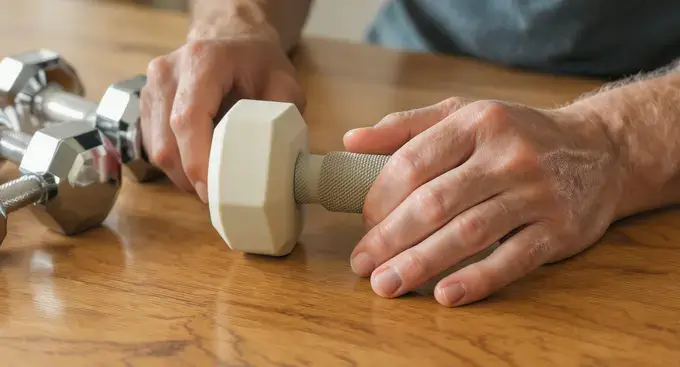
A hexagonal or flat-sided design prevents rolling if dropped—an important safety feature. For weight increments, choose adjustable sets or pairs in small jumps (like 1-2 pounds) so you can progress gradually without straining joints or connective tissue.
What weight dumbbells should a 70 year old use?
Starting weights can vary, but a general guideline for a 70-year-old beginner is to use 2-5 pounds for upper body exercises (like bicep curls) and 5-15 pounds for lower body movements (like goblet squats). The right weight lets you complete your target reps with perfect form, feeling challenged by the last two reps but not strained. It’s always best to start too light rather than too heavy, and progress slowly.
Supporting your strength training with proper nutrition is just as important as the exercises themselves. Research shows that older adults doing resistance training benefit from increased protein intake to support muscle repair after exercise. Source: NIH/PMC
That means spreading protein evenly across your meals, especially in the hours around your workout.
Don’t overlook hydration either. Older adults may have a diminished thirst sensation, making proactive hydration essential. The CDC notes that fluid needs increase with physical activity. Source: CDC
Drink water consistently throughout the day, not just during your home workout for seniors. Keep a water bottle nearby and sip regularly.
When you combine the right equipment with targeted nutrition, you create a powerful synergy. Manageable weight increments allow for progressive overload, while adequate protein provides the building blocks for the muscles you’re challenging. Add consistent hydration to support joint lubrication and cellular function during your functional training, and you’ve got a holistic approach that makes your strength training efforts effective, safe, and sustainable for the long haul.
Sources
- ACSM – Older Adults Strength Training
- Seaton Senior Living – Exercises to Avoid with Osteoporosis
- Cooper Institute – Hypertension and Weight Training
- Franciscan Health – Exercise After Joint Replacement
- B-One Training – Role of Deload Weeks
- NIH/PMC – Protein Intake for Muscle Repair
- CDC – Fluid Needs and Physical Activity