Essential Leg Machine Names and Primary Functions
Leg workout machines names can be confusing, but knowing what each does is the key to smart and efficient lower body training. Each machine is designed to isolate or combine specific muscles through controlled movements for precise strength and muscle building.
The leg press machine is a fundamental compound movement. You’ll sit or recline and push a weighted platform away with your feet. This targets your quads, glutes, and hamstrings while supporting your lower back—making it a safer alternative to heavy barbell squats for many lifters.
The hack squat machine positions you with your back against a padded sled. As you descend into a squat and push upward, you’ll feel intense quad emphasis with significantly less strain on your lower back. It offers a guided, barbell-like motion that’s excellent for building foundational strength.
For isolation work, the leg extension machine is your go-to. You’ll sit and extend your knees against resistance from a padded roller, isolating the quads for pure knee extension. On the flip side, the leg curl machine (lying or seated) isolates your hamstrings by having you curl your heels toward your glutes.
Don’t overlook the hip adductor and abductor machines. The adductor machine works your inner thighs as you squeeze your legs together, while the abductor targets your outer hips and glutes by pushing your legs apart. These are vital for pelvic stability and balanced musculature.
The calf raise machine, whether seated or standing, targets your gastrocnemius and soleus muscles by having you push up onto your toes. Finally, while not exclusive to legs, the Smith machine provides a guided barbell path for exercises like squats and lunges, offering enhanced stability for learning proper mechanics.
What are the names of the leg machines?
The primary leg machines you’ll find in most gyms are the leg press, hack squat, leg extension, leg curl (lying or seated), hip adductor, hip abductor, and calf raise machines. The Smith machine is also commonly used for leg exercises like squats.
Safety Guidelines and Injury Prevention for Leg Machines
Using leg machines safely comes down to proper setup, controlled form, and listening to your body. Ignore these principles and you’re heading straight toward injury, regardless of the weight you’re moving.
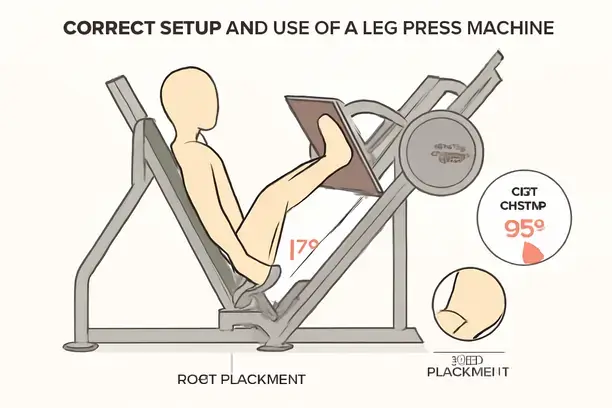
Always adjust the machine to fit your body. For the leg press, position the seat so your knees are at a 90-degree angle when your feet are on the platform, keeping your back flat against the pad. On the leg extension, align the machine’s axis of rotation with your knee joint, and make sure the pad rests just above your ankles.
Here are critical movement errors to avoid:
- Locking out joints: Never fully lock your knees at extension—maintain a slight bend to prevent hyperextension.
- Losing stability: Keep your hips, lower back, and shoulders firmly planted. Lifting your butt off the pad or arching your back transfers dangerous stress to your spine.
- Using momentum: Control the weight throughout the entire range of motion. No bouncing or jerking.
Learn to recognize your body’s warning signs. Sharp, sudden pain means stop immediately. Dull, persistent aches often signal overuse or poor technique.
Joint grinding or clicking—especially with pain—can indicate cartilage issues, while numbness may point to nerve compression.
Essential safety protocols you can’t skip:
- Always use the safety pins on machines like the leg press.
- Start light to master form before adding weight.
- Warm up thoroughly with dynamic stretches and light cardio.
- Breathe correctly: exhale during the exertion phase (pushing/pressing), inhale on the return.
What is the best machine to strengthen your legs?
The “best” machine depends on your goal. For overall leg strength, the leg press is a top choice since it safely loads multiple major muscle groups. For targeted quad development, the hack squat or leg extension work brilliantly, while the leg curl is best for isolating the hamstrings.
Structured Programming: From Beginner to Advanced
A strategic plan is what turns random gym sessions into consistent progress. Effective programming gives you clear sets, reps, and progression strategies tailored to your experience level.
If you’re just starting out, begin with a simple 2-3 day per week full-body or lower-body split. Focus on compound machines like the leg press and hack squat, aiming for 3 sets of 8-12 reps per exercise. Use linear progression: add 2.5-5 pounds or an extra rep each session to build a foundation of strength and technique.
Intermediate lifters can implement a double progression system. First, master a weight for all target reps across all sets. Then, increase the weight slightly and work to master that new load. This method creates sustainable progress and helps you avoid plateaus.
For advanced lifters chasing hypertrophy, intensity techniques can break through stalemates. Use these sparingly—perhaps 1-2 times per workout:
- Drop Sets: After reaching failure, immediately reduce the weight by 20-30% and continue for more reps to extend time under tension.
- Rest-Pause: Use a heavy load (70-80% of your max) for a set to near-failure, rest 15-20 seconds, then knock out mini-sets until you can’t maintain form.
Periodize your training by cycling through different rep ranges in 4-8 week blocks—strength (3-6 reps), hypertrophy (8-12 reps), and endurance (15-20 reps). Tracking your workouts in a journal is essential for recognizing patterns and knowing when to push forward.
Rehabilitation and Adaptive Use of Leg Machines
Leg machines can be powerful tools for rehabilitation when you use them with intentional modifications and professional guidance. Their controlled movement pathways allow for precise loading and range-of-motion adjustments.
The leg press is particularly versatile for rehab. You can adjust foot placement, limit the depth of the movement, and use very light loads to gently rebuild strength. For knee rehabilitation, the leg extension machine requires careful use. While traditionally controversial post-ACL surgery, controlled, limited-range motion (often from 90 to 60 degrees) can be beneficial for quad reactivation after the initial healing phase.
Specific modifications are crucial for common injuries:
- ACL Rehab: Start with limited-range leg presses and extensions, focusing on control over load. Avoid deep flexion early on.
- Hamstring Strains: Use the leg curl machine with a reduced range of motion to avoid stretching the injured tissue. Begin with isometric holds before progressing to full movement.
- Hip Issues: Use hip abduction/adduction machines with extreme caution, minimal resistance, and limited range. Avoid any position that causes pain.
Key contraindications include using heavy resistance during acute injury phases, exercising through painful ranges of motion, and ignoring alignment. Always work with a physical therapist to develop a protocol tailored to your specific condition and recovery stage.
Check This
Home and Minimal-Equipment Alternatives
You can build impressive leg strength without access to a full gym. Many machine-based exercises have highly effective bodyweight or minimal-equipment counterparts that target the same muscle groups.
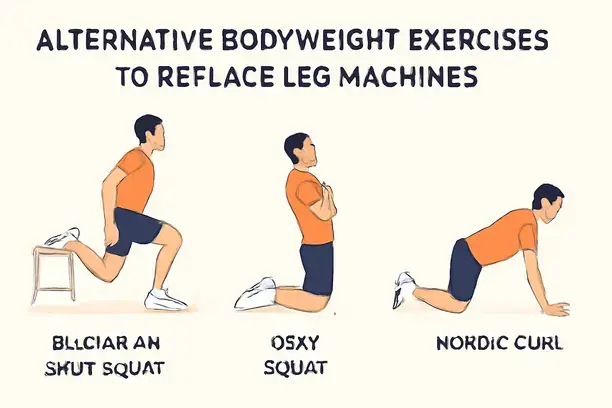
Here are key machine alternatives:
- Leg Press → Bulgarian Split Squats or Goblet Squats: These single-leg or weighted squat variations build serious quad and glute strength.
- Leg Extension → Sissy Squats or Reverse Nordic Curls: These challenging bodyweight moves isolate the quads effectively.
- Leg Curl → Nordic Curl Negatives or Slider Leg Curls: Excellent for hamstring development. Start with the eccentric (lowering) phase of a Nordic curl if the full movement is too difficult.
- Hip Ad/Abduction → Side Lunges & Clamshells: Add a resistance band around your thighs for extra intensity on clamshells to mimic the abduction machine.
A sample no-equipment leg workout could include:
- Bulgarian Split Squats: 3 sets of 10-12 per leg
- Sissy Squats: 3 sets of 8-10
- Nordic Curl Negatives: 3 sets of 5-8
- Side Lunges: 3 sets of 12-15 per side
For progressive overload at home, focus on increasing reps, slowing your lifting tempo, adding pauses, or incorporating resistance bands. Consistency with these alternatives ensures you can maintain and build leg strength anywhere. Leg workout machines names.
What are the 10 types of strength training machines?
While this article focuses on legs, common strength machines across the gym include: Leg Press, Hack Squat, Leg Extension, Leg Curl, Hip Abductor, Hip Adductor, Calf Raise, Chest Press, Lat Pulldown, Seated Row, and Shoulder Press machines. The Smith machine is also a multi-use staple.
Sources
- 3D Muscle Journey – Rest-Pause and Myo-Reps
- Everyday Health – Leg Press Machines and Back Injuries
- Everyday Health – Why Leg Presses Hurt My Knees
- Healthline – Leg Curl Alternatives
- Men’s Health – Leg Extension Alternatives
- National Center for Biotechnology Information – Patellofemoral Pain and Hip Strength
- Reshape – Hypertrophy Techniques: Drop Sets & Myo-Reps
- Skelcore – Leg Press Machines: Variations and Benefits